
Eliminating Radiation Leaks: The 3 Most Overlooked "Fatal Blind Spots" in X-Ray Room Construction
Eliminating Radiation Leaks: The 3 Most Overlooked "Fatal Blind Spots" in X-Ray Room Construction
As a source manufacturing factory with 20 years of deep expertise in medical equipment and radiation protection, we have observed through serving global medical institutions and delivering numerous international projects:The effectiveness of radiation shielding in X‑ray rooms depends not on the thickness of main materials alone, but on whether details are fully addressed. X‑rays, especially scattered radiation, possess strong penetrating and refracting properties. Even the tiniest physical gap can become a pathway for radiation leakage.
Today, we reveal the three critical blind spots in X‑ray room radiation shielding construction that most often lead to failure in environmental impact assessments, along with our professional shielding solutions.
Blind Spot 1: Gaps and Bottom Sagging of Radiation-Shielding Lead Doors
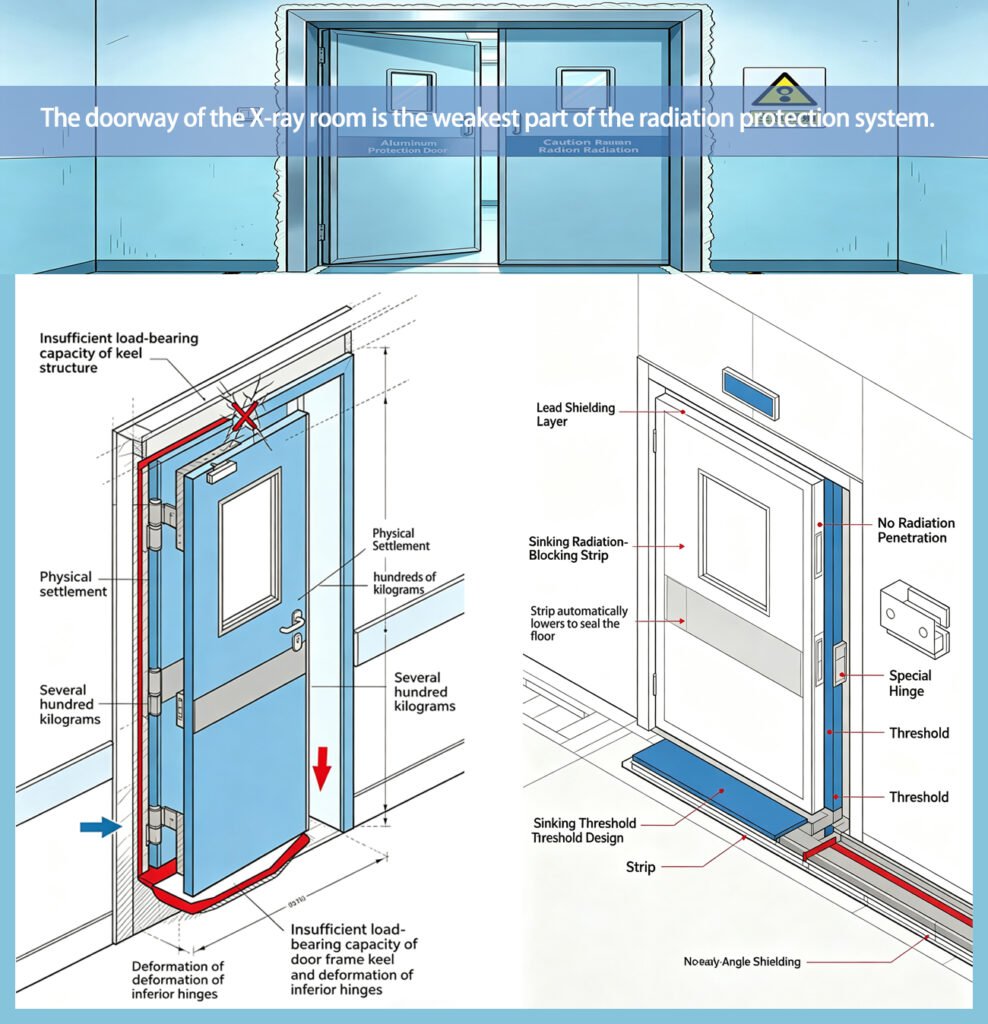
The entrance and exit of an X-ray room represent the weakest link in the entire shielding system.Many construction crews install radiation-shielding lead doors the same way as ordinary wooden or security doors, which is a major mistake. Filled with high-equivalent pure lead sheets, a single medical lead door can weigh hundreds of kilograms or even more.
- Cause of Leakage: If the frame keel lacks sufficient load-bearing capacity or inferior hinges are used, the lead door will experience physical sagging after just a few months of frequent opening and closing.This creates a gap larger than 3mm between the bottom of the door leaf and the floor.Scattered X-rays will escape directly into the external corridor through this floor gap, much like flowing water.
- Professional Solution: At the manufacturing stage, heavy-duty load-bearing tracks (for sliding doors) or floor-ceiling shafts / specially engineered load-bearing hinges (for swing doors) must be used.More importantly, a retractable radiation-proof bottom seal or a sunken threshold design is required at the base.This ensures that when the door is closed, the lead shielding forms a perfect physical interlock with the floor, achieving true hexahedral gap-free shielding.


Blind Spot 2: Voids Around Through-Wall Penetrations and Electrical Socket Back Boxes
- Risk Index: ⭐⭐⭐⭐ Modern X-ray rooms and CT rooms require extensive connection of strong and weak electrical pipelines, air conditioning ventilation ducts, and medical gas pipelines. To install these pipelines, construction personnel must drill openings in walls that have already been lined with lead sheets.
- Causes of Radiation Leakage: Many unprofessional construction teams only use ordinary plaster or foam adhesive for backfilling after drilling openings. From the perspective of X-rays, these standard power sockets, switch back boxes and air conditioning vents act like “large holes” in the protective wall. Radiation can penetrate the socket panels without obstruction and irradiate adjacent rooms.
- Professional Solution: A Maze-type Shielding Design must be adopted. Any opening made in a protective wall must be fitted with dedicated lead backing boxes on the rear side. The lead equivalent of the backing boxes shall be greater than or equal to the standard lead equivalent of the wall, and sufficient overlapping with the main lead sheets of the wall shall be ensured at the edges. For large air conditioning vents, custom-made radiation-proof louvers with built-in lead baffles shall be used to force radiation attenuation to safe levels through multiple reflections.
Blind Spot 3: "False Overlapping" at Lead Sheet Joints and Internal/External Corners
- Risk Index: ⭐⭐⭐⭐ The installation of radiation shielding lead sheets is not comparable to wallpapering; simply aligning the edges is absolutely insufficient.
- Causes of Radiation Leakage:To save materials or for convenience, construction personnel often butt the edges of two lead sheets directly together. Due to thermal expansion and contraction or slight wall vibration, tiny cracks (as small as 0.5 mm) that are barely visible to the naked eye can easily form at the joints, allowing high-energy radiation to penetrate through. Similarly, at internal and external corners of the room, if the lead sheets are not bent and formed properly, these areas will become frequent radiation leakage points.
- Professional Solution:Strictly implement the Mandatory Overlap Protocol. An effective overlap width of no less than 10–15 mm must be ensured between adjacent lead sheets. When treating wall corners, cutting and joining at the corner should be avoided; instead, a single piece of lead sheet should be used and bent into an L-shape to wrap the corner. In addition, all nail holes used to fix the lead sheets must be secondarily covered and sealed with lead caps or lead paste of equivalent lead equivalence.

Ultimate Strategy for One‑Pass Acceptance: Choose a Professional Source Factory with Engineering Expertise
Medical radiation shielding engineering is a life‑safety system that permits no trial and error. Rather than incurring high costs for demolition and rework after failing environmental radiation assessment, it is wiser to select a professional system supplier from the outset.
As an export‑oriented enterprise integrating in‑house manufacturing and international trade services, we not only supply high‑quality radiation‑shielding lead sheets with full thickness and a purity of 99.994% and customized lead doors, but also deliver construction techniques conforming to top international standards. From preliminary drawing optimization and radiation attenuation calculation to anti‑leakage design at pipeline and penetration nodes, we apply 20 years of professional expertise to every project detail.
Do not allow tiny gaps to ruin your multimillion‑dollar investment in an imaging center.Contact our radiation shielding engineering experts for a customized zero‑leakage protection solution.


Have a question?
Get a free quote
We will contact you within 24 hours.